Development
2D vs 3D Game Development: Compare the Production, Not Just the Look
Choose a dimensional approach by examining controls, content pipelines, camera needs, and team strengths.
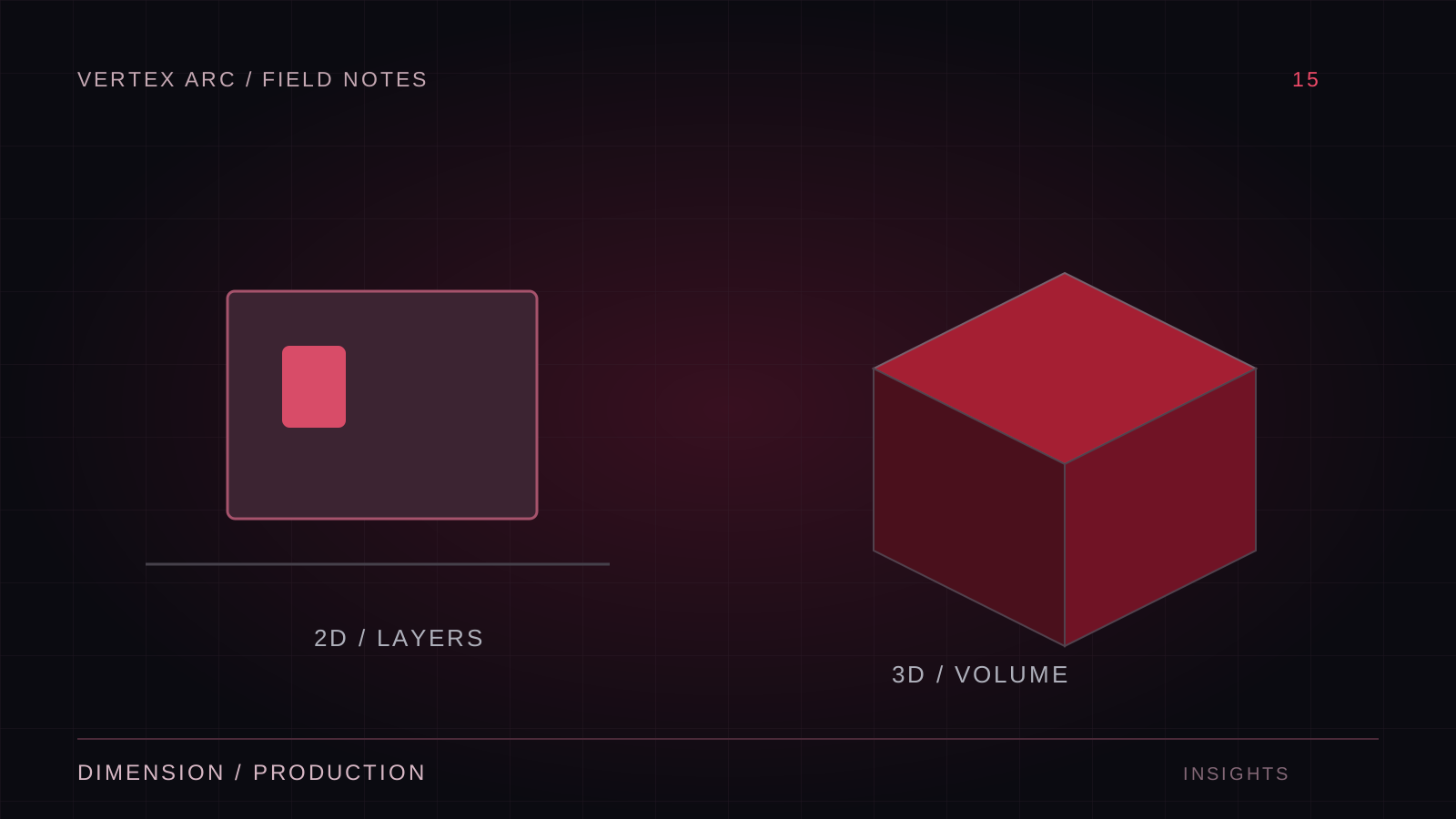
Choosing between 2D and 3D is not simply choosing between inexpensive and expensive. A richly animated 2D game can require substantial art production, while a restrained 3D game can reuse modular assets effectively. The real question is which approach supports the experience and the team's ability to produce it consistently.
Begin with the player's view and actions. Does depth create meaningful decisions? Does the camera need to rotate? Is precise silhouette readability more important than exploring a space from every angle? These questions help separate a design requirement from a visual preference.
Compare the content pipeline
In 2D, investigate sprite creation, animation, layering, resolution, and variation. A character facing multiple directions may multiply the work needed for each action or equipment change. In 3D, investigate modeling, rigging, materials, animation, lighting, and asset integration. Reusable rigs can help, but they still need reliable setup and validation.
Make one representative character and one representative environment element before estimating the full project. Track revisions as well as initial creation. The cost of changing an animation or adding a new outfit often reveals more than the cost of the first finished asset.
Account for camera and collision complexity
A fixed 2D camera can simplify visibility, but scrolling, parallax, and small-screen composition still require careful design. A free 3D camera introduces collision, occlusion, aiming, and motion-comfort concerns. These are gameplay systems with production costs, not automatic benefits supplied by the engine.
Collision also follows the experience rather than the image alone. A visually 2D game may use 3D geometry, and a 3D-looking game may constrain movement to a plane. Decide which representation makes the rules easiest to implement and understand. Hybrid approaches can be effective when the boundaries are explicit.
Test the style on target hardware
Neither dimension guarantees performance. Large transparent layers, oversized textures, or excessive UI work can make a 2D game demanding. Complex lighting, materials, and dense scenes can make a 3D game demanding. Profile a representative scene instead of relying on a category label.
Review readability at actual scale
Look at enemies, projectiles, text, and interactable objects at the expected display size. Detailed art may become visual noise during fast movement. A style that reads clearly can reduce the need for additional outlines, indicators, and effects later.
Match the approach to the team
Existing expertise matters because production is repeated work. A team comfortable with skeletal animation may iterate faster in one pipeline; a team of illustrators may have a different advantage. Plan for the skills the project needs throughout its life, including tools, maintenance, and content expansion.
- Build one complete asset through the intended pipeline.
- Test a representative gameplay camera and input scheme.
- Estimate revision costs, not only first-pass costs.
- Check how equipment, enemies, and environments scale in quantity.
- Verify the style on the minimum supported device.
Choose the approach that sustains the game
A small comparison prototype can reveal whether the visual direction strengthens or complicates the core interaction. Keep the test narrow and use the same gameplay question in both versions. The goal is not to declare a universal winner, but to understand the tradeoffs for this project.
Choose 2D, 3D, or a hybrid because it supports the game you can actually make. A coherent style and dependable production pipeline matter more than the dimension itself. The strongest choice is the one the team can refine, extend, and ship with confidence.