Industry
Smarter Game Development Workflows: Tools, AI, and Human Judgment
Evaluate automation by its effect on iteration, reliability, and creative control—not by the size of its output.
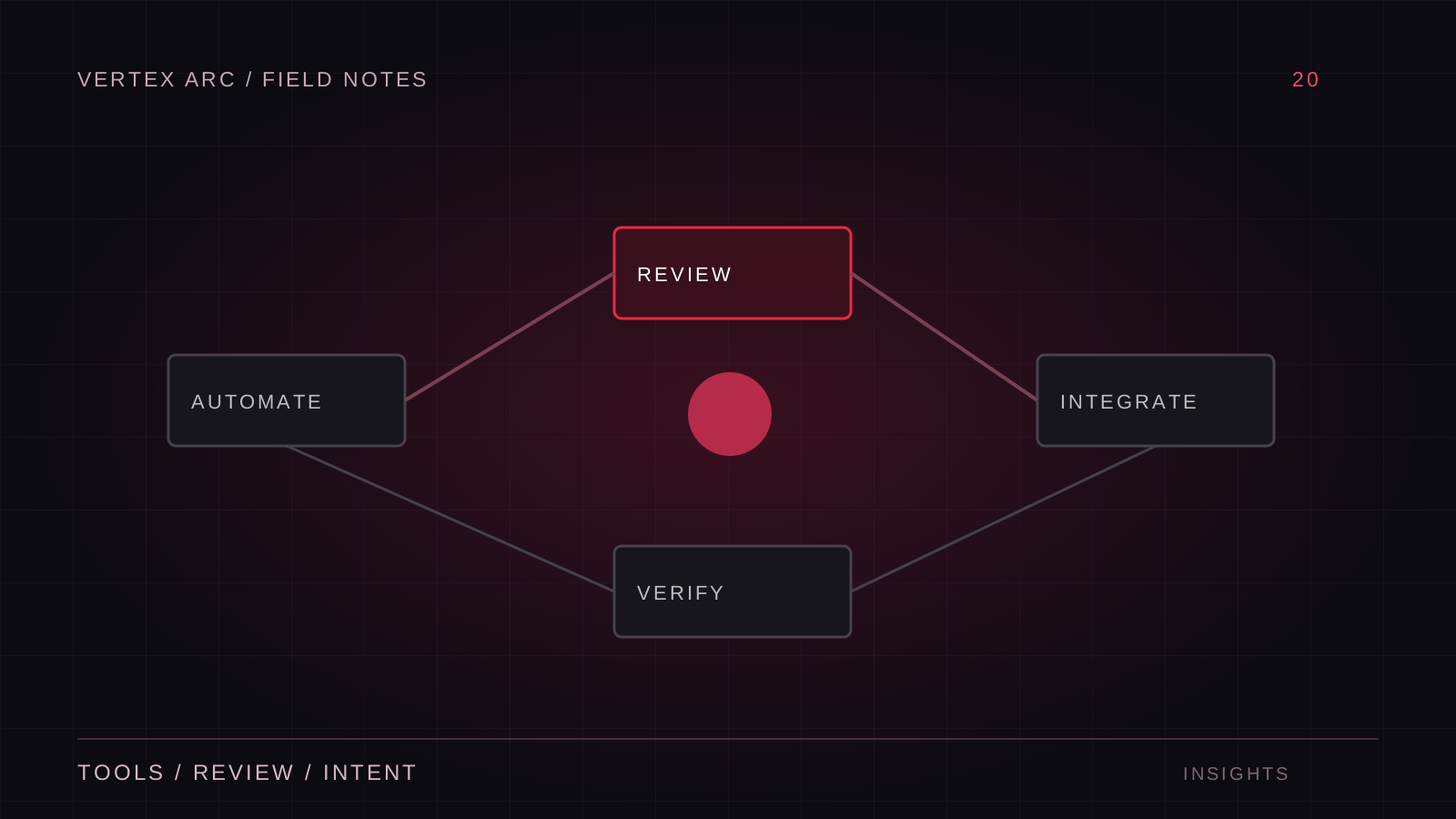
New tools can make it easier to generate code, explore visual directions, and automate repetitive production work. The useful question is not how much material a tool can produce, but whether it improves the team's ability to make and maintain a coherent game. Faster output can create slower production if review, integration, and debugging grow faster than the work it replaces.
Treat emerging workflows as experiments. Choose a bounded task, define a useful result, and compare the complete process with the existing approach. Include correction and maintenance time. A demonstration that ends at the first plausible output leaves out much of the work required to ship.
Automate predictable work first
Asset validation, naming checks, build packaging, and repetitive data conversion are good candidates because success can be described clearly. These tasks often benefit from ordinary scripts as much as from AI. Choose the simplest tool that gives a reliable, inspectable result.
Keep automation reversible and visible. Show what changed, preserve source inputs, and make failures actionable. A script that silently repairs ambiguous data can hide a problem the team needed to understand. Validation that explains the issue may be more valuable than automatic modification.
Use AI assistance within a reviewable boundary
AI can help explore implementation options, draft documentation, or suggest test cases. Its output still needs review against the project's architecture and behavior. A plausible API name or convincing explanation is not proof that the code is correct for the engine version in use.
Evaluate the whole integration cost
Check dependencies, performance, edge cases, and whether another contributor can understand the result. Ask the tool to work on a limited change with clear acceptance criteria. Smaller changes are easier to compare, test, and reverse than a large generated system whose assumptions are spread across many files.
Protect the creative direction
Variation is useful during exploration, but production needs consistency. Art direction, character behavior, terminology, and interface patterns should be guided by explicit references and review. More options do not automatically create a stronger identity. Selection and refinement remain central creative work.
For generated assets, review the applicable tool terms and the rights associated with inputs and outputs before incorporating them into a commercial project. Keep provenance and approval records alongside other asset information. Avoid putting confidential project material into a service without confirming that the team is authorized to do so.
Improve the feedback loop
The most valuable tools shorten the distance between a question and trustworthy evidence. A better profiler workflow, faster build deployment, or a clear content validation report may improve development more than another way to create assets. Measure how quickly the team can discover and correct a problem.
- Can the output be reproduced or traced to its inputs?
- Can a contributor review the change without specialist guesswork?
- Does the workflow handle failure clearly?
- Is the saved time still present after integration and testing?
- Can the project continue if the service becomes unavailable?
Keep decisions with the people responsible
Automation should make responsibility easier to exercise, not obscure it. Assign owners to generated or automated changes just as you would to manually authored work. Document important assumptions and verify behavior in the actual build. The player experiences the shipped result, regardless of how it was produced.
The future of a useful workflow is not a contest to remove the most human involvement. It is a practical effort to remove unnecessary friction while preserving judgment, quality, and creative control. Adopt tools where they help the team learn and deliver, and keep evaluating them as the project changes.