Multiplayer
Building Multiplayer Games: Decisions to Make Before Production
Plan authority, latency, sessions, and failure recovery before networking becomes a costly retrofit.
Multiplayer changes the meaning of game state. In a single-player prototype, one process can decide what happened and immediately show the result. Across a network, messages arrive late, can be lost, and may describe actions that conflict. The game needs rules for ownership, reconciliation, and recovery before these conditions become bugs players encounter together.
Start by describing the shared experience. A turn-based board game, a cooperative platformer, and a competitive shooter have different timing and trust requirements. The architecture should follow those requirements. Adding networking after every mechanic assumes instant local control usually creates more work than testing a small networked loop early.
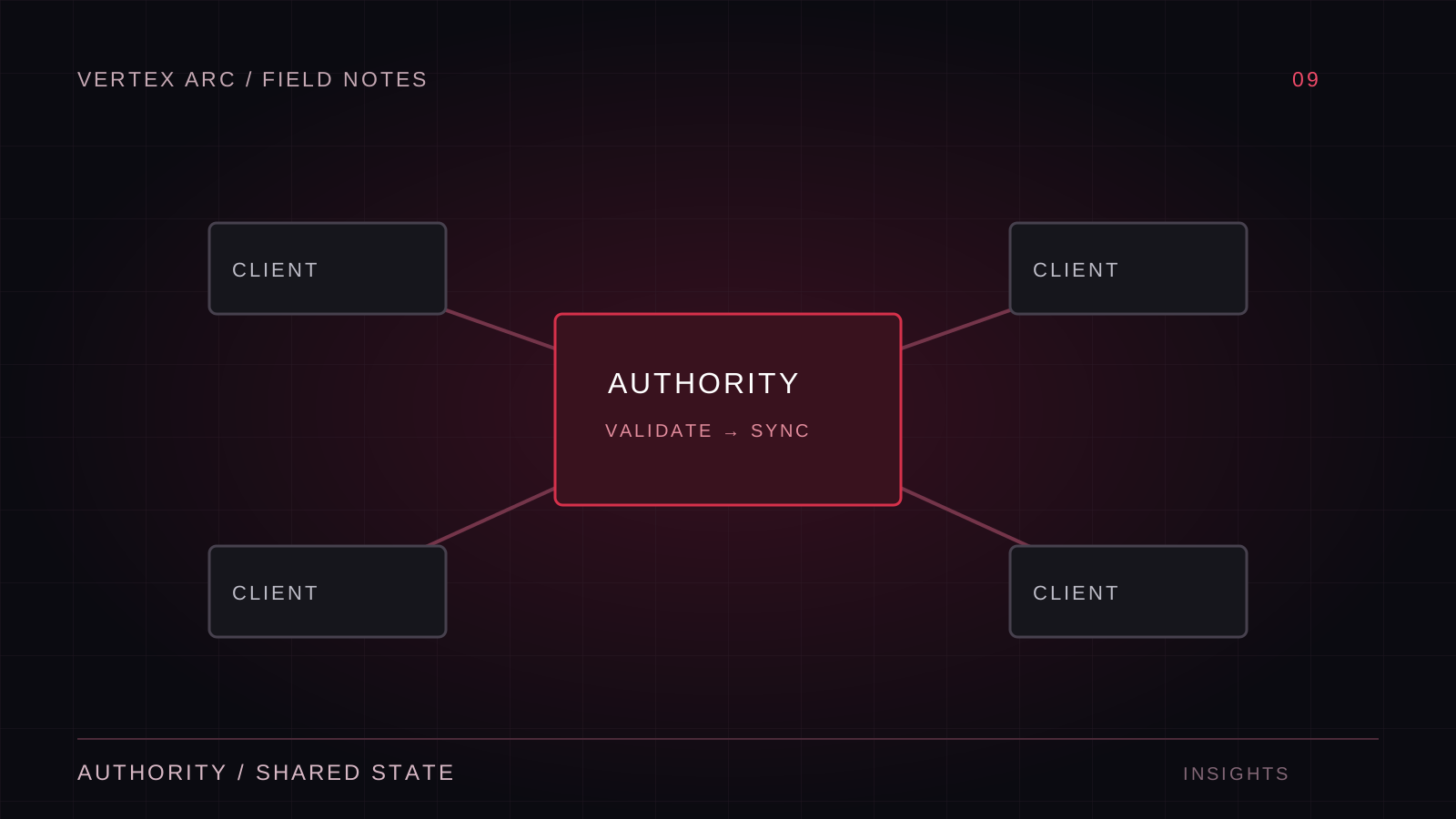
Decide who owns the truth
Authority defines which participant may make a final decision about a piece of state. A server may own health and inventory while clients request actions. Client-owned presentation can still be immediate, but a request is different from a confirmed result. Keep that distinction visible in both code and user experience.
A listen server, hosted by a participant, and a dedicated server have different costs and failure modes. Consider trust, host advantage, session size, operational expense, and what happens when the host leaves. There is no universal topology that fits every project. Prove the chosen model with the actual gameplay loop before expanding content.
Design for latency rather than hiding it
Players need timely feedback. Prediction can let a local player see an action before authoritative confirmation, while reconciliation corrects differences later. Interpolation can smooth remote motion using received snapshots. These techniques solve different problems and require careful handling when the predicted result differs from the server's decision.
Decide which actions can be speculative. A muzzle flash is easier to correct than a permanent item purchase. For important state changes, design pending, confirmed, and rejected outcomes. A button that silently does nothing during a network delay gives the player no way to distinguish waiting from failure.
Keep messages purposeful
Send the information needed to reconstruct relevant state, not every local detail. Decide which objects a participant needs to know about and how frequently their state changes. Bandwidth, server work, and client work all grow with the amount of replicated activity. Test with realistic session sizes instead of assuming two local windows represent the final load.
Separate commands from persistent state
A transient effect can be represented as an event; a door's open state must remain understandable to a late joiner. If opening the door is only an event sent once, a new player may never learn that it happened. Review each feature for joining, reconnecting, and observing after its initial activation.
Treat sessions as a complete journey
The match is only part of multiplayer. Players must discover a session, join it, load compatible content, understand readiness, and recover from interruption. Build that journey alongside gameplay. Clear errors and retry behavior are essential when a join request fails or a version mismatch prevents participation.
Define how identity relates to a connection. A reconnecting player may need to reclaim an existing seat rather than create a duplicate character. Temporary identifiers should not become accidental permanent account keys. Document session lifetime and cleanup so abandoned sessions do not remain indefinitely.
Validate requests at the authority boundary
Do not assume a client request is valid because the normal interface would only send it in an appropriate situation. Check ownership, action timing, resource availability, and allowed transitions. A server that accepts impossible movement or repeated rewards undermines fairness even if the transport itself is reliable.
Make operations that may be retried safe to repeat where possible. A repeated confirmation should not award an item twice. Keep enough diagnostic context to understand rejected requests without logging unnecessary personal data. Security and correctness overlap strongly in multiplayer state management.
Test the network you will actually encounter
Simulate latency, jitter, packet loss, and disconnection. Test remote devices, not only multiple editor instances. Include the uncomfortable cases: a player leaves during a transition, reconnects during combat, or submits an action just as the round ends. These boundaries often reveal assumptions that ordinary play does not.
- Verify late joining and reconnecting after state changes.
- Check the host or server failure path.
- Test duplicate and delayed requests.
- Measure a representative full session.
- Confirm that clients converge on the same authoritative outcome.
Plan for operating the game
Estimate infrastructure needs from measured sessions, and include deployment, monitoring, version compatibility, and incident recovery in the production plan. A working local match does not demonstrate that the service is ready to operate. Keep server and client releases traceable so a problem can be tied to the exact deployed versions.
Successful multiplayer starts with clear ownership and honest handling of delay and failure. Build a small remote-playable slice early, test adverse conditions, and let those findings shape the rest of the game. The result is a system designed for players sharing a network, rather than a local game hoping the network behaves perfectly.